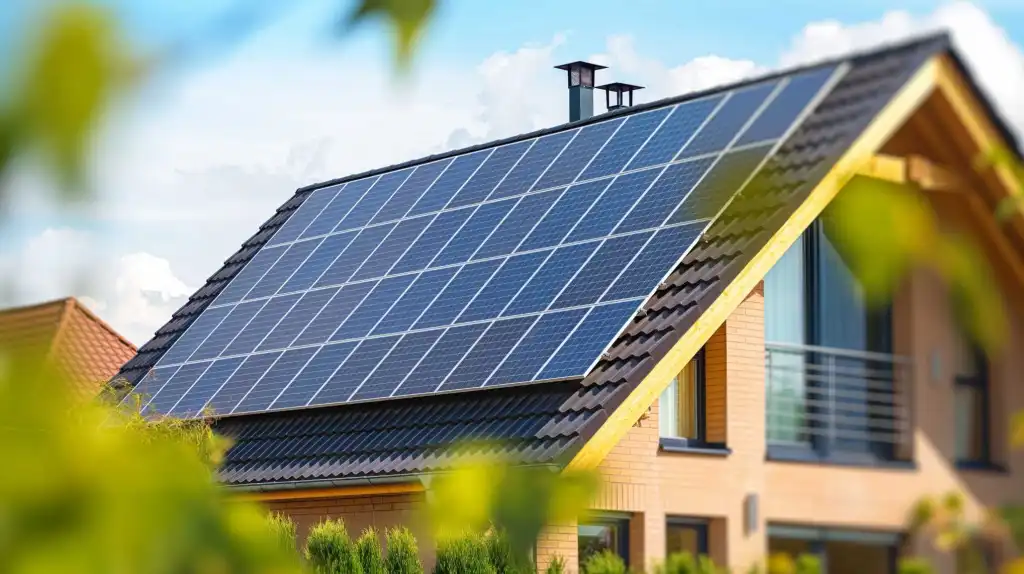

Solar panels work by using silicon cells to absorb sunlight and knock electrons loose, creating a flow of direct current (DC) electricity. An inverter then converts that DC power into alternating current (AC), the type of electricity that powers your home’s outlets, appliances, and lights. No moving parts, no combustion, no fuel — just photons hitting silicon and physics doing the rest.
That’s the short version. But “how solar panels work” is really three separate processes stacked together: the physics inside the cell, the wiring that turns tiny currents into usable power, and the system that gets that power into your home or the grid. Below, we break down each stage, show you the real specs behind residential panels, and compare the two main cell technologies so you know what you’re actually buying.
Quick Summary Box
| Key Takeaway | What It Means |
|---|---|
| ⚡ The core process | Sunlight → electron movement (photovoltaic effect) → DC electricity → inverter → AC electricity |
| 🔬 Main material | Over 95% of panels use crystalline silicon cells (monocrystalline or polycrystalline) |
| 📊 Typical efficiency | Residential panels convert 18–23% of sunlight into usable electricity |
| 🏠 System components | Panels + inverter + racking + wiring + (optional) battery storage |
| 🔋 Lifespan | Most panels are warrantied for 25 years, with output degrading roughly 0.3–0.5% per year |
The Photovoltaic Effect: Where It All Starts
Every solar panel is built from photovoltaic (PV) cells — thin wafers of silicon that have been treated with other elements (usually phosphorus and boron) in a process called doping. This treatment creates two distinct layers:
- N-type layer (top): has extra free electrons
- P-type layer (bottom): has “holes” where electrons are missing
Where these two layers meet, an electric field forms. When sunlight — specifically, photons — strikes the cell, that energy knocks electrons loose from the silicon atoms. The electric field at the N-P junction pushes those freed electrons in one direction, creating a flow of electricity. This is the photovoltaic effect, first observed in 1839 and commercialized into practical cells in the 1950s.
A single cell only produces about 0.5 volts, which is why panels wire dozens of cells together — typically 60, 66, 72, or 120 cells per panel — to reach a usable voltage output.
From Sunlight to DC Electricity
Once electrons are flowing, metal conductive strips on the cell’s surface collect that current and route it to the panel’s junction box. At this stage, the electricity is direct current (DC) — power that flows in one direction, the same type of electricity produced by batteries.
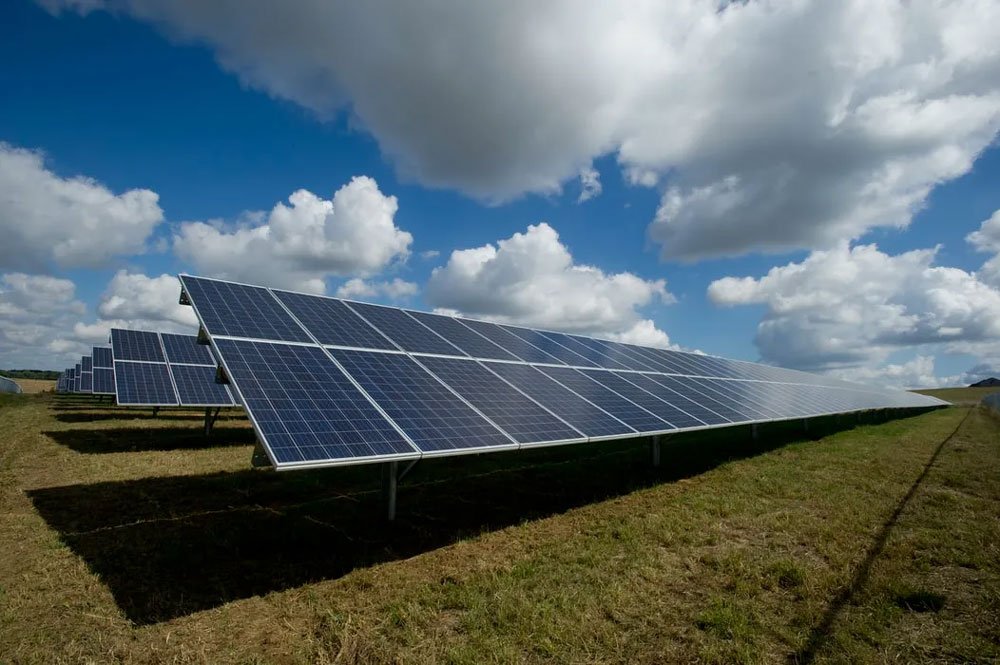
Multiple panels are wired together in strings, connected in series or parallel depending on the system design, to combine their output into a higher-voltage DC current ready for conversion.
The Inverter: Making Power Usable
Homes and the electrical grid run on alternating current (AC), not DC. That’s where the inverter comes in — it’s arguably the most important piece of hardware in a solar system after the panels themselves.
There are three common inverter setups:
String Inverters –
A single central inverter converts the combined DC output of an entire panel string into AC. This is the most common and cost-effective setup for straightforward roof layouts.
Microinverters –
A small inverter is attached to each individual panel, converting DC to AC at the panel level. This improves performance on roofs with partial shading, since one underperforming panel doesn’t drag down the whole string.
Power Optimizers –
A hybrid approach — DC power is “conditioned” at the panel level, then sent to a central string inverter for final conversion. It captures some of the shading benefits of microinverters at a lower cost.
Getting Power Into Your Home
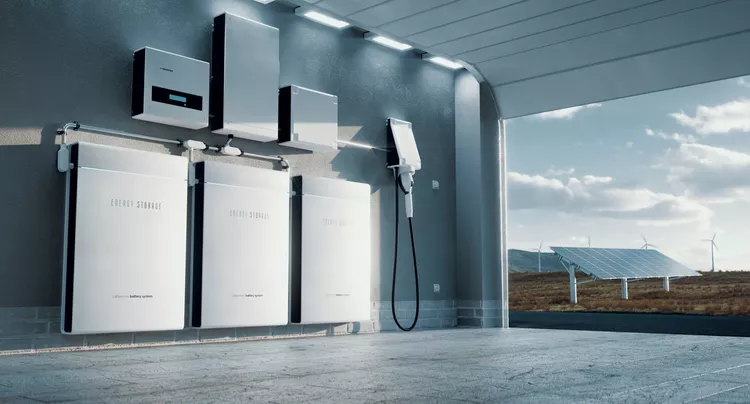
Once converted to AC, electricity flows through your home’s electrical panel just like grid power. Any excess your system generates — more than your home is using in that moment — typically goes one of two ways:
- Exported to the grid, often earning credit through net metering programs
- Stored in a home battery for use after sunset or during outages
At night, or whenever your panels aren’t producing enough, your home automatically draws from the grid (or battery) instead. This switching happens instantly and invisibly — most homeowners never notice the transition.
Monocrystalline vs. Polycrystalline: What’s the Difference?
Not all silicon cells are made the same way, and the manufacturing method affects efficiency, appearance, and price.
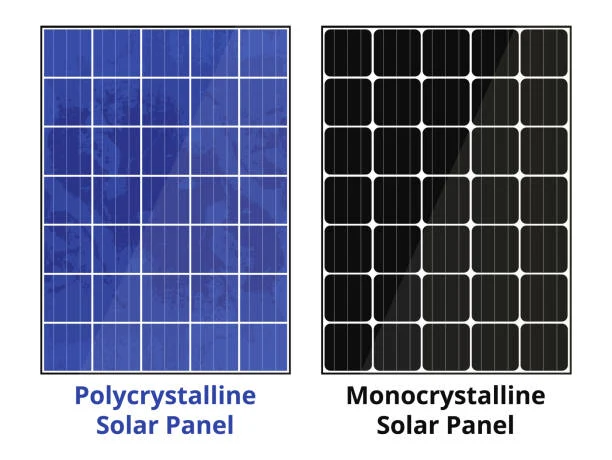
Monocrystalline Cells
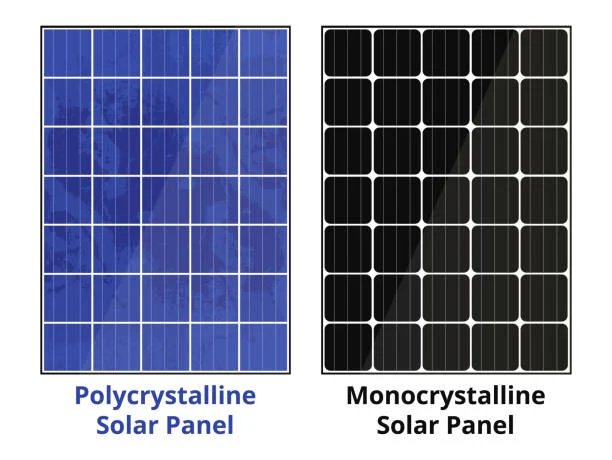
Cut from a single, continuous silicon crystal. This uniform structure lets electrons move more freely, resulting in higher efficiency (typically 20–23%) and a sleeker, uniform black appearance. They cost more to produce but deliver more power per square foot — important for roofs with limited space.
Polycrystalline Cells
Made by melting multiple silicon fragments together, resulting in a distinctive blue, speckled look. The less uniform crystal structure means electrons have more resistance to overcome, so efficiency is lower (typically 15–18%). They’re cheaper to manufacture, making them a budget-friendly option when roof space isn’t a constraint.
Why Efficiency Numbers Matter More Than You’d Think
A panel’s efficiency rating tells you what percentage of sunlight hitting the panel actually converts to electricity. The rest is lost to reflection, heat, and resistance in the wiring. Small differences compound: a 22%-efficient panel will produce meaningfully more electricity than an 18%-efficient panel of the same physical size, over the same 25-year warranty period.
Temperature also plays a role. Every panel has a “temperature coefficient” — typically around -0.3% to -0.5% output per °C above 25°C (77°F). This is why solar panels are actually slightly less efficient on scorching summer afternoons than on cool, sunny spring days.
Comparison Table: Monocrystalline vs. Polycrystalline Panels
| Spec | Monocrystalline | Polycrystalline |
|---|---|---|
| Efficiency | 20–23% | 15–18% |
| Cell appearance | Uniform black | Speckled blue |
| Space needed per kW | Less (higher output density) | More |
| Typical cost per watt | Higher (~$0.90–$1.10) | Lower (~$0.70–$0.90) |
| Temperature performance | Slightly better in heat | Slightly more affected by heat |
| Lifespan/warranty | 25 years, similar degradation rate | 25 years, similar degradation rate |
| Best for | Limited roof space, max output | Larger roofs, tighter budgets |
Pricing reflects general market ranges for panel hardware only (before installation labor, permitting, and incentives) and varies by region and manufacturer.
Bottom Line
Solar panels work through a straightforward chain: sunlight excites electrons in treated silicon, that movement creates DC electricity, and an inverter converts it into the AC power your home actually uses. The physics hasn’t changed in decades — what’s improved is efficiency, with modern monocrystalline panels now converting over a fifth of incoming sunlight into usable electricity. For most homeowners with limited roof space, monocrystalline panels are worth the premium; for larger roofs where space isn’t the constraint, polycrystalline panels still deliver solid, budget-friendly performance.